(Upon reading “Mind at the End of Its Tether” by H.G. Wells)
Saith the Sage, there is no Shape of Things to Come; there is only the Coming of Shapelessness. Maps crumple—yea, and also the landscapes they signify— into dimensionless wads of nothing; the clock’s hands are blurred the whole way round; the eons snap their fingers in our faces. The very NOW contracts its steel coils and breaks our ribs and squeezes our breath away. There is no way out or round or through.
The bitter wisdom of the Sage begins with the knowledge of vanity; the multitude is not disposed to know and so it will never know. In the glass-walled formicary of this world, the ants keep faith in the magical placations of their leaders, whose bigotries blossom into radiant cruelty. The subservient fear-haunted mind in its blind libidinous craving to exist retreats into a sanctuary of jaded reassurance, the idiot’s recital of the everyday.
There is no way out or round or through; the way ahead is steeply up or steeply down. May mind climb the rungs of the air and the worm aspire to the stars? To go steeply up is to cease to be human; our heirs are creatures we know nothing of.
Gluttonous time devours us all; the cherished delusion of recurrence is dead; gravitation’s golden cord is frayed; earth slows in its spinning, and the years and days grow longer; the equinoxes wobble in their precession; night no longer follows day, nor day the night; there are naught but new things under the dying sun; we lie when we say we have seen them before. There is no way out or round or through.
Now that mind, that strange intruder, that peculiar throb in matter, is at its final ebb, the grinning Antagonist goads us with the riddle: “Is this all?” For the more we reach the less we grasp in saecula saeculorum— for ever and ever. Amen.
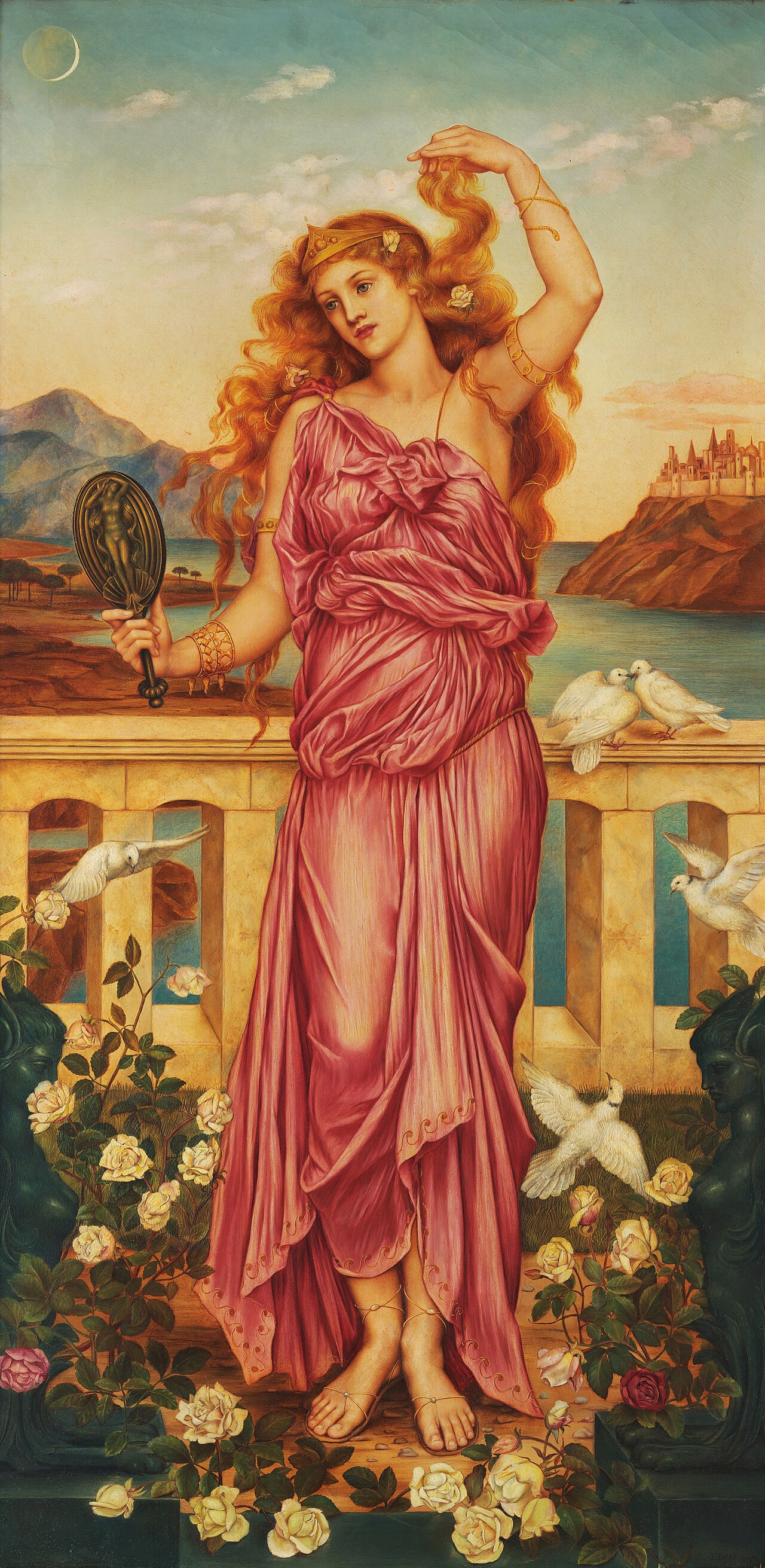
The play takes place inside a tent near the walls of Troy. The Trojan War has just ended; the flicker of flames from the burning city can be seen through the fabric. Trojan women are heard moaning and weeping outside. Helen sits looking into a mirror; her reflection looks back at her, mimicking her movements until it begins to speak for itself.
HELEN. Mirror, mirror—it’s now or never. I’ll know soon whether I’m to live or die; it’s up to Menelaus to decide. When the war started, you promised to tell me a secret whenever it ended. Well, the war has ended. The Greeks are burning Troy right now; they’ve ruined the city and everything in it— everything except this face that killed thousands of men; time and hatred, twin warriors of ruin, have done that for them. So keep your promise. Tell me now.
REFLECTION. Such foolish chattering, when your life is at stake. Get to work now, try to save yourself.
HELEN. How?
REFLECTION. Do you really need me to tell you? Don’t you still have your box of pretty lies?
(HELEN opens a decorative box.)
HELEN. Yes, everything’s been taken from me except for that—and you.
REFLECTION. Well, you need lies now—lies to soothe your husband’s anger and make him believe you worth ten years of stupid carnage, lies spread thick to hide the truth, these acres of cracks and flaws and furrows. Now get to work—and quickly.
(As the REFLECTION speaks, HELEN applies makeup from the box.)
REFLECTION. First, honey and oils to soften this brittle flesh, deep beetroot dye to brighten these bloodless cheeks, mulberries crushed in beeswax to make moist and red these scorched and pallid lips, and antimony, too, to shroud these swollen eyes— for beauty, false or true, is impossible without a pinch of poison. And last, dabs of tinctured marjoram, myrrh, and spikenard, so you’ll smell sweet—or to hide the scent of fear.
HELEN. These jeweled combs and pins, this gold diadem— they’re tarnished and need polishing.
REFLECTION. They’ll have to do.
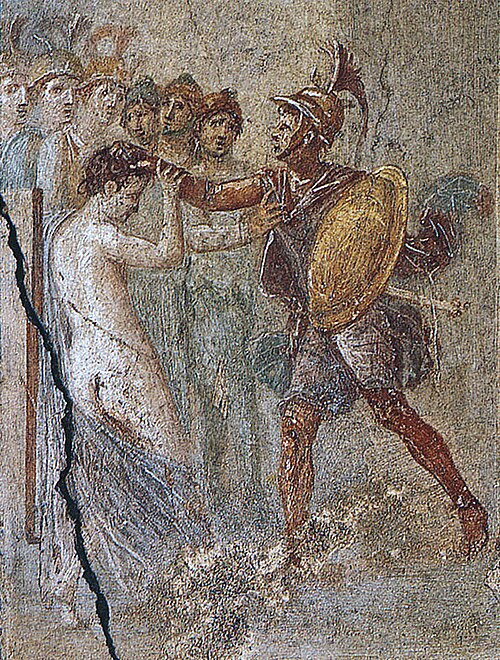
Menelaus captures Helen in Troy, detail of fresco in Pompeii.
(The WOMEN’S VOICES are shouting: “Kill her, Menelaus! Kill Helen! Kill her now!”)
HELEN. My golden-haired husband has arrived.
REFLECTION. Yes, and scented now with lilies and roses, not the sweat of battle. Queen Hecuba and all the Trojan women still alive beg him to put you to the sword instead of carrying you back alive to Sparta. They’ll soon be shipped to Greece, enslaved or turned to whores, and all because of you. So who can blame them?
HELEN. Well. The choice isn’t mine. These gaudy lies must do their work or fail. Menelaus, I come.
(HELEN turns to go.)
REFLECTION. Wait. Don’t you want to hear my secret?
HELEN. I didn’t think you’d tell me.
REFLECTION. I may be a liar, but I keep my promises. Sit with me a moment.
(HELEN sits again and starts to weep; REFLECTION reaches out of the mirror and dabs her eyes.)
REFLECTION. Oh, don’t, my dear, you’ll ruin all your hard work.
HELEN. Why am I to blame? I never chose anything, any of this.
REFLECTION. Then whose fault is it? One civilization staggers home to lick near-mortal wounds, another will soon lie in a heap of rock and glowing embers. Troy and Greece alike have lost their most precious manhood— great-hearted Patroclus slain by horse-taming Hector, Hector by swift-footed Achilles, Achilles by magnificent Paris, and Paris by … oh, I have lost track. And poor mad Ajax, killing innocent sheep until he threw himself upon his own sword. But last night—worse than all ten years of carnage, women dragged from their houses and raped, their children slaughtered; blood now pools in the streets, black and thick like tar. Someone must be to blame.
HELEN. Enough. Your secret. You promised.
REFLECTION. Yes, the secret. Tell me—where were you last evening before the slaughter of all innocence began? You did something interesting, I believe.
HELEN. What does that have to do with—?
REFLECTION. Tell me.
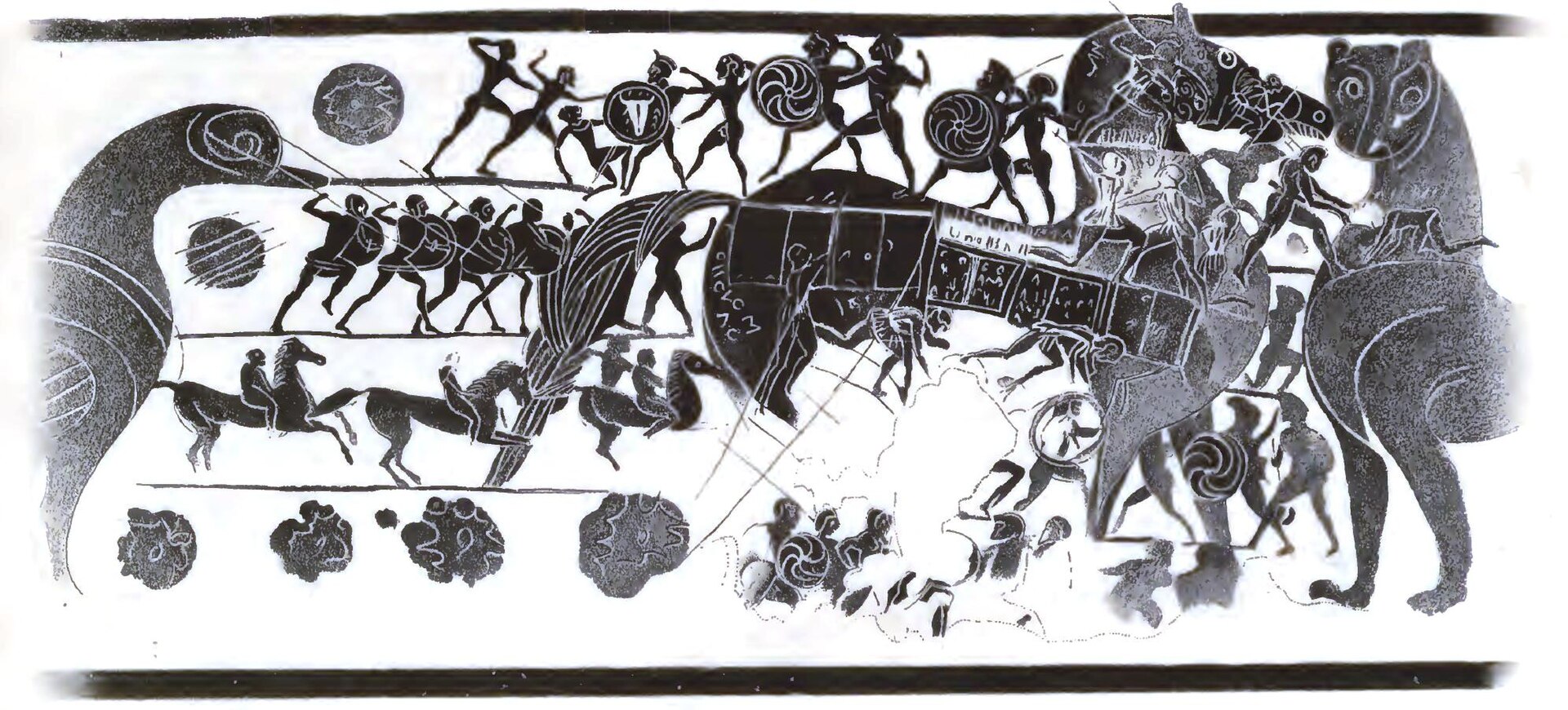
Depiction of the Trojan Horse on a Corinthian aryballos (ca. 560 BC) found in Cerveteri (Italy).
HELEN. I went out of the palace to see the gift— that wooden horse the Greeks had brought as a ruse, standing silent in the bloody sunset. When no one else happened to be nearby, I touched its sides and sensed what no Trojans yet had— the presence of some forty soldiers waiting for the silent hour to climb out and open the city gates. And as I walked around the horse, I pretended …
REFLECTION. Pretended?
HELEN. No, became Aegialia, the lovely bride Diomedes left behind those ten long years ago; I whispered through the horse’s ribs of aching pleasures he’d dreamed of all those nights— pleasures only I knew how to give. I heard him weeping and walked on round the horse and then became Laodice, King Priam’s daughter, loved by the Greek Acamas before the war began, but parted from him ever since; I sang a little love song we used to sing together, which made him weep as well. And round I went again and again until the soldiers groaned and sobbed with homesickness, almost loud enough for someone else to hear. Crouched at last beneath the horse’s belly, I became patient Penelope, Odysseus’s wife, and murmured what a fine young man his son was growing up to be back home in Ithaca, and what a shame it was he didn’t know his father. But wily Odysseus alone did not weep; instead, he forced the others to be silent. I went back to the palace and tried to sleep until I heard the madness in the streets.
REFLECTION. So you became those women in those moments; what makes you think you’re Helen now? In fact, you’re none of them, and not Helen, either. You’re no one at all—a cloud, a mist, a vapor, shaped by Queen Hera in a woman’s form to trick all men; a phantom for Paris to abduct in the true Helen’s stead.
HELEN. No. It’s impossible. How can somebody be … ?
REFLECTION. Nobody at all?
HELEN. I feel pain, so much pain, the salt-sting of tears on this cheek, blows of time and hatred bruising my flesh, splinters of lies stuck in my tongue, broken shards of shame cutting my heart. I feel it all.
REFLECTION. Pain, too, can be a cloud, a mist, a vapor. None of what you feel is real.
HELEN. And the real Helen?
REFLECTION. Hermes spirited her away when you were made— far away for safe-keeping until the war is over when she will be returned to her husband in Sparta and he will never be the wiser.
HELEN. I don’t believe this. Look at me. I’m growing old, I’m crumbling like this city’s walls and hopes. What need has a cloud for lotus flowers and marigolds, lavender and chamomile and resin? What need has a phantom for a box of lies?
REFLECTION. What kind of illusion would you be if you didn’t fade and decay? The real Helen has passed these years untouched by time, by hate, by men, while you, her phantom, succumb to the ravages of a woman’s vanity and pride. And that’s as it should be. Now go to your husband without fear, for you will be perfect in his eyes. The perfect woman and the perfect cloud— they are the same thing, infinitely mutable, ever shaping themselves to men’s thoughts and dreams, mere reflections, phantoms of the mind. Those weeping women of flesh and blood outside, so full of grief, terror, and thoughts all their own— they’ll never make their captors happy. Someday Menelaus will sit gazing at the real Helen by firelight wondering, “Who is this woman? How dull and real she is! Why ever did we fight a war for her?” But wars must be fought. Any excuse will do. That’s what clouds are for.
HELEN. They are proud, aren’t they, those men who still live?
REFLECTION. Oh, yes. They have made the best war there has ever been. They can think of nothing grander to do than that.
(HELEN speaks with mounting anger.)
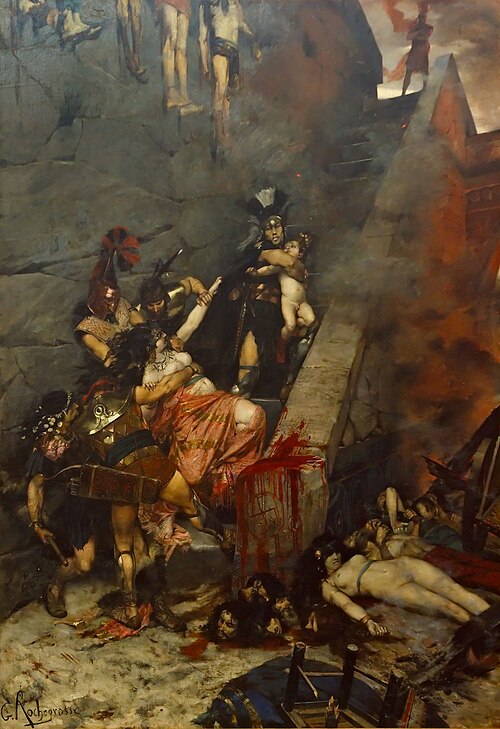
HELEN. Such heroes they are! A short while ago they killed a little boy— Astyanax, son of Andromache and Hector. They tore him from his mother’s arms and hurled him from high battlements to his death. How scared the poor child must have been! And how brave the Greeks felt killing him! It was the last and proudest deed of a war they fought not for treasure or glory or power, nor even for a whore of flesh and blood, but for nothing—no thing at all. For me! A cloud!
Astyanax torn from the arms of his mother Andromache to be killed by the Greek leaders. Painting by Rochegrosse.
REFLECTION. Go to him now. Don’t put it off.
HELEN. What’s to become of me when I’ve fulfilled my purpose— when Menelaus reaches home and holds the real Helen in his arms?
REFLECTION. You will dissolve, of course; you’ll disappear into thin air.
HELEN (laughing). Oh, no, my friend, I think not.
REFLECTION. I’m telling you the truth.
HELEN. And I believe you—I am a cloud.
REFLECTION. Yes, impalpable and weak.
HELEN. A moth is weak, but its wings seize gusts of air by the fistful and forge from them rain and hail and wind, cacophonous lances of fiery lightning, surging waterspouts, torrential desolation, downbursts of the sheerest terror. A single moth flings its slumbering tempests awake across the world, and I will do the same. I may be weak, but I gather the strength of uncreation. I’ll seize the thunderbolt from Zeus’s hand, the earthquake trident from Poseidon, force Hades to unlock his iron doors and let death itself rush forth. I’ll chase the gods away from sea, earth, and sky, and rob the cosmos of every vestige of divinity.
REFLECTION. A world without gods.
HELEN. A world without meaning.
REFLECTION. You almost frighten me.
HELEN. My own face, frightened of me! Good! Now what do you see when you look at me?
REFLECTION. You have become Chaos primordial born anew into this rotten world, a scourge of rage and tumult filled with hatred for this age of heroes.
HELEN. The peaceful Aegean stretches now between the Greeks and home promising them a safe and easy voyage. But the salty dregs of the deep shall rise into mountains at my shrill clarion command to shatter and thwart and destroy them. Oh, I must go to Menelaus now, this very instant! I’m ready!
REFLECTION. No, my dear—you mustn’t hurry; why not savor your honeyed vengeance? You have eternity at your command; yours is the power to turn all mortal kin against themselves and each other, against their world, to goad men to make mad and futile war upon the earth, sea, and sky, until the elements put them to the end they well deserve. Let this moment mark the end of legends; from now on, let the nightmare of history wreak its patient annihilation.
HELEN. Oh, yes—how sweet!
REFLECTION. Besides, you mustn’t let your unwary husband see you in this dreadful form; he’ll flee from you, and that will be the end of it. To work again with your box of lies.
(HELEN opens her box again.)
HELEN. What picture shall I make of myself today?
REFLECTION. Do you need to ask? A pretty, painted moth.
(HELEN makes herself up as women howl and flames roar.)
… but what is the question, really? What is Hamlet actually talking about? I was pretty slow as a teenager, so when I asked a high school English teacher this question, of course he told me, as teachers always do …
“Hamlet is contemplating suicide.”
The trouble was, I couldn’t quite make sense of it. Yes, I understood what all the words meant—that “quietus” was a settlement of a debt, a “bare bodkin” was a dagger, “fardels” were burdens or loads, the “undiscover’d country” was death, and all the rest of it.
First Folio, 1623
But wasn’t taking “arms against a sea of troubles” a rather odd way of describing suicide? And what about those “enterprises of great pitch and moment” that “lose the name of action” that Hamlet talks about at the end? Surely, I suggested, Hamlet wasn’t talking about suicide there.
I succeeded only in convincing my English teacher that I was a great deal dumber than he already knew me to be. And who was I to argue? I let the matter rest for a long time.
It wasn’t until many years later that I discovered the 1982 Arden edition of Hamlet, edited by the late Shakespeare scholar Harold Jenkins. Thirty years in the making, it was so exhaustively (and exhaustingly) annotated that Jenkins couldn’t fit all of his annotations on the pages of the text itself; he added another 150 pages of notes at the end. It was a dream for a Shakespeare geek like me. I devoured every word.
And when I got to that all-too-famous soliloquy of Act III, scene i, I was in for a special treat. The speech was annotated first with about a page and a half of footnotes, then with another eight and a half pages of endnotes—a total of around 10 pages of annotation altogether.
To my delight, I found that Jenkins devoted most of those notes to proving my high school teacher (and just about everybody else) wrong …
It is impossible … to say that Hamlet ever contemplates suicide for himself or regards it as a likely choice for any man.
For one thing, this is the only soliloquy of Hamlet’s (out of seven in all) that never once uses first person singular pronouns like “I” and “me.” Nor does he mention his father’s murder, his uncle’s usurpation, his mother’s remarriage, or anything else having to do with the story of the play. Hamlet isn’t talking about his own specific situation at all, but about what life is like for all of us.
And his “question,” as Jenkins sums it up, is simply, “Is life worth living?” Hamlet goes on to give us a lot of reasons why life might not be …
… the whips and scorns of time, Th’oppressor’s wrong, the proud man’s contumely, The pangs of dispriz’d love, the law’s delay, The insolence of office, and the spurns That patient merit of th’unworthy takes …
And of course, right then Hamlet does mention the possibility of suicide—after all, one could always do oneself in with a “bare bodkin.” But according to Jenkins,
this is a rhetorical question, which already presupposes its answer, a hypothetical question brought in only to be dismissed.
Not only do we shy away from suicide; we also avoid positive actions that might make a real difference in the world. We don’t wind up doing much of anything about life’s “sea of troubles” for fear of failure—or death.
And according to Jenkins, that “sea” is a richer image than we may have realized:
Edwin Booth as Hamlet, ca. 1870
The metaphor appears to be based upon well-known instances, notably that of the Celts, who, as described by various ancient authors, rather than show fear by flight, would draw their swords and throw themselves into the tides as though to terrify them.
A desperate and futile gesture, certainly. You could even call it suicidal, since it’s surely not going to end well. But suicide isn’t really the point. It’s about doing something—anything—against the manifold torments of existence. It’s also about accepting the fact that you’re doomed to lose—or at the very least to die in the attempt. Hamlet learns this bitter truth himself at the end of the play.
Most of us don’t dare undertake any such endeavor, in no small part due to our fear of the “undiscover’d country” of death …
Thus conscience does make cowards of us all, And thus the native hue of resolution Is sicklied o’er with the pale cast of thought, And enterprises of great pitch and moment With this regard their currents turn awry And lose the name of action.
As Jenkins puts it,
we come to the end of life’s “troubles” not when we put an end to them but when they put an end to us.
… one of the most unjust [wars] ever waged by a stronger against a weaker nation …
Ulysses S. Grant in 1843
That was how Ulysses S. Grant described the Mexican-American War of 1846-48 in his Personal Memoirs. Years before he commanded the Union Armies during the American Civil War, Grant served in Mexico as a young lieutenant. Make no mistake, it was a brutal war of conquest that vastly expanded the United States while seizing 55% of Mexico’s land.
I ran across the quote back in 1998 while compiling a book of source materials about the war in Mexico. Grant’s eventual nemesis, Robert E. Lee, also served in that war as a captain. Did Lee share Grant’s bitterness about the conflict? While looking for an answer, I ran across a strangely haunting document. On April 12, 1848, shortly after the war’s end, Lee wrote a letter from Mexico City to a lady cousin back home in Virginia. The letter begins …
Robert E. Lee, c.1850
I rode out a few days since for the first time to the church of Our Lady of Remedios. It … is said to be the spot to which Cortez retreated after being driven from the city on the memorable Noche Triste.…
Lee refers here to the fabled Noche Triste of June 30-July 1, 1520 (now officially known in Mexico as la Noche Victoriosa), when Hernán Cortez and his army, routed by the Aztecs, fled Tenochtitlan. The letter continues …
I saw the cedar tree at Popotla … in which it is said he passed a portion of that night. The “trees of Noche Triste,” so called from their blooming about the period of that event, are now in full bloom. The flower is … of the most magnificent scarlet color I ever saw. I have two of them in my cup before me now. I wish I could send them to you.…
The letter fascinated me, evoking as it did an image of a man who would later play such a traitorous role in U.S. history treading in footsteps of that much earlier warrior, Hernán Cortez. As I read the rest of it, I wondered what thoughts and emotions lurked between its lines—homesickness, despair, horror, regret? I didn’t know then, and I don’t know now. But the question moved me to write this sestina, loosely based on Robert E. Lee’s letter …
Last night I rode out for the first time, lady— rode west into the hills that looked like wax molded by moonlight, and rested beneath a tree with scarlet blossoms burdening its limbs. (Even by night they were a brilliant hue.) The night seemed sorrowful—a Noche Triste.
Long ago on another Noche Triste (is not the night always a plaintive lady?) a Spaniard fled, his moonlit face the hue of pallid rout, as damp as fevered wax. Conquered Cortés paused and rested his limbs, weeping lost men and treasure beneath that tree.
I have two perfect blossoms from the tree in a cup before me—twin flowers of Noche Triste. They ease my soul, they please my aching limbs; I wish that I could send them to you, lady. I’ll bring you two facsimiles of wax, but they can’t duplicate this scarlet hue.
As the moon shimmered yet more pale in hue, I rode farther in hills beyond the tree to where Cortés, conquistador of wax, ended his retreat on that Noche Triste. There stands the little chapel of Our Lady settled beneath the sky’s nocturnal limbs.
Inside, I found the Virgin’s likeness—her limbs clad in a petticoat of silver hue, her head encircled with a crown. Our Lady stood amid branches of a maguey tree, and as befitted such a Noche, Triste seemed to me her smile of lovely wax.
And all around her, shaped from pallid wax, were sundry disembodied human limbs— offerings left on some past Noche Triste by those the Virgin healed. Their routed hue whispered of sad Cortés beneath his tree; and weary from my ride, I slumbered, lady,
and dreamed her tears were molten wax, the hue of Our Lord’s bloody limbs nailed to a tree. Ah, such a Noche Triste for Our Lady!
—Wim
After the death of Moctezuma, Cortés and his forces leave Tenochtitlán. The Mexica spot them and fiercely attack the Spanish and their allies. Oil on canvas from the 17th century.
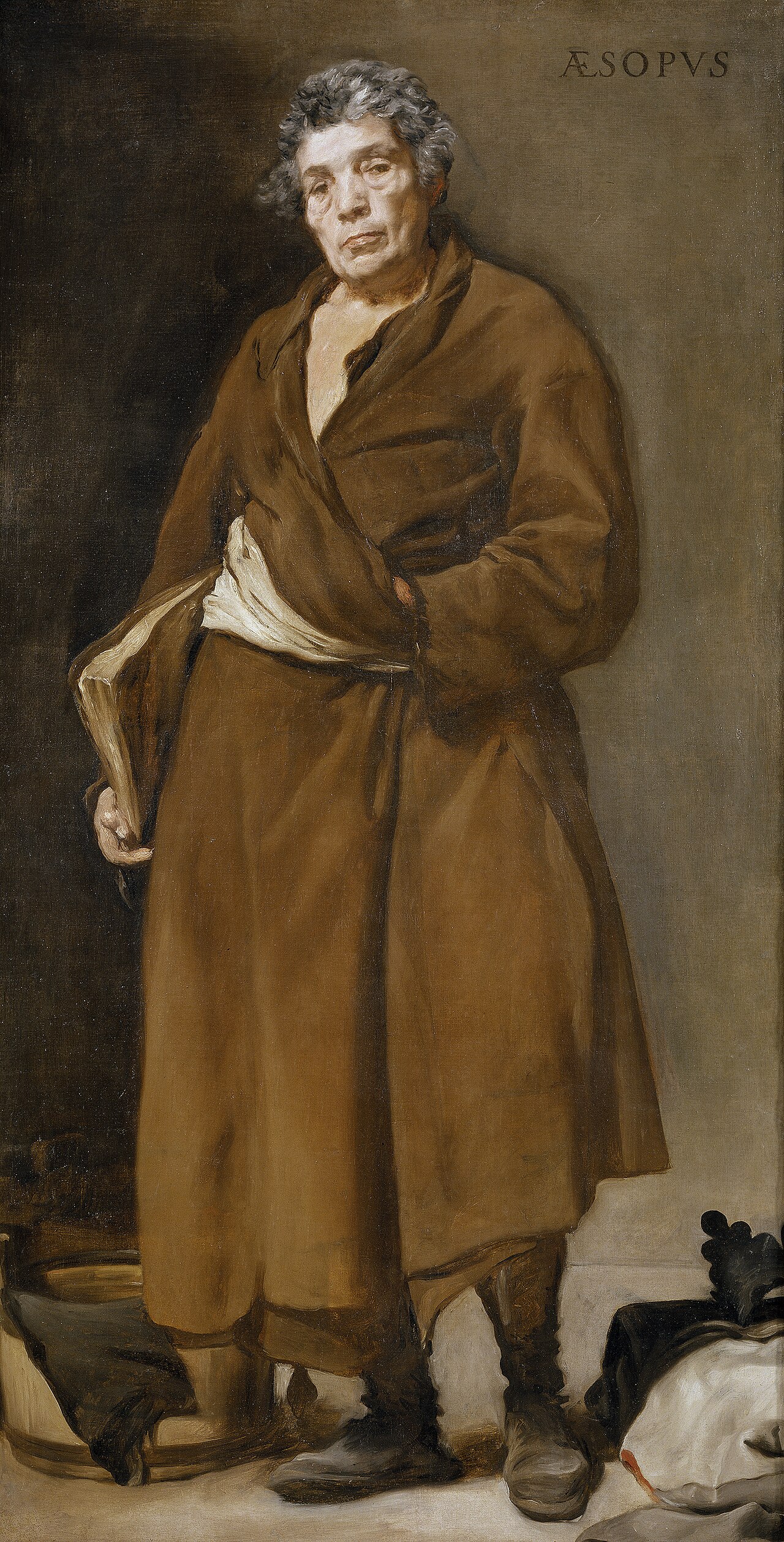
The Lullaby Tree, my play about the life of Aesop, is available in hardback, paperback, and Kindle. It has been described as “a no-holds-barred literary and theatrical extravaganza of ideas that reels riotously between prose and verse, vulgarity and beauty, farce and heartbreak, earthiness and mysticism.” Who am I to disagree?
Like Hamlet, Aesop has a third-act soliloquy:
Exeunt all except Aesop.
I am alone—or so I say Because I am supposed to; You know the truth is not a thing I’m really quite disposed to. And flights of verse treat facts much worse Than statements spoke in prose do.
“I am alone”: Let it be known, I find those words most queer. For I am standing on a stage, Addressing you loud and clear, While you are sitting in your chairs Pretending you’re not here.
I am alone, I am alone, Standing at stage center, Awaiting someone who may be My savior or tormentor— Waiting, waiting, nothing more, For someone else to enter.
I am alone; watch closely now— Yes, you and all your chums— This tap-tap-tapping of my toes, This twiddling of my thumbs. My tongue I’ll click, my nose I’ll pick, Till something this way comes.
I am alone; so seize this time (It really would be wise) To hold each other by the hand, To stroke each other’s thighs, Or gaze and gaze, entranced, amazed, Into each other’s eyes.
I am alone; now aren’t I A fascinating sight? For you can’t look away from me; Tell me if I’m not right. For you can’t look away from me; Try it with all your might.
I am alone and wear a mask, Just as all actors should. And yet—I touch my face and feel That it is flesh and blood. Now touch your frozen face—you’ll find It’s linen, cork, or wood.
“I am alone”: These words have spun A gripping spell, it’s true; Moments are passing, lost and gone— Moments that you shall rue; For when you peep in a play too deep, The play peeps into you!